One of the most brutal and horrific chapters of Bangladesh’s 1971 Liberation War unfolded at Dakra, a village in the Rampal region of Bagerhat. On May 21, 1971, local Razakars—collaborators with the Pakistani military—launched a barbaric assault, slaughtering hundreds of innocent Hindu refugees and local residents.
Eyewitness accounts paint a haunting picture of that terrifying day.
The Setting: Dakra and Its Geography
Dakra is a quiet, secluded village in the Perikhali Union of Rampal Upazila, situated near the Sundarbans. The village is crisscrossed by the Kumarkhali and Madartala canals, with the Mongla River flowing nearby. The local Dakra Bazar sits right along the southern bank of the Madartala Canal.
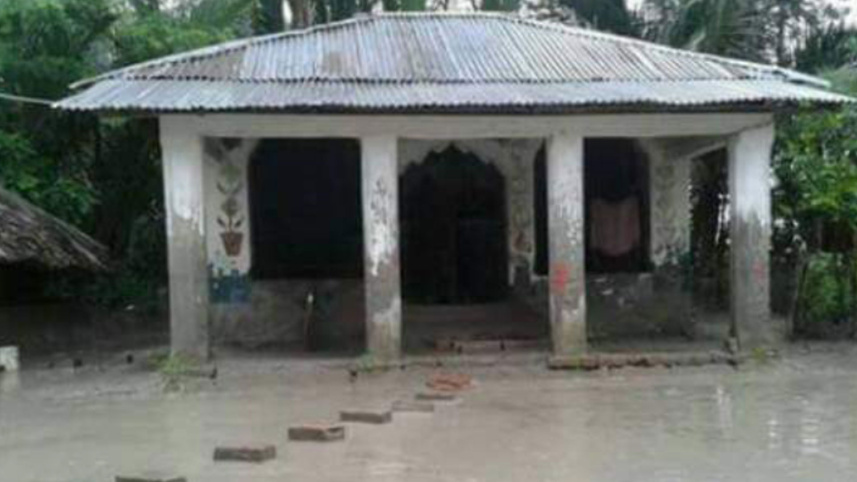
At the heart of the village stood a century-old Kali Temple. Surrounding it was the Thakur Bari (the priest’s estate), home to several Brahmin families who had served as the temple’s custodians for generations. At the time, the spiritual leader of the temple was Binod Bihari Chakraborty—revered locally as ‘Noakorta’—and the chief priest was Badal Chandra Chakraborty.
The Inflow of Refugees and Treacherous Assurances
By early May 1971, as persecution against the Hindu community escalated across the region, local families began preparing to flee the country. However, local Muslim League leaders and members of the Peace Committee (Shanti Committee) assured them of complete safety, urging them not to leave.
Afsaar Uddin, a local Peace Committee member, personally guaranteed the chief priest that neither the Razakars nor the Pakistani army would harm any devotees.
Relying on these assurances, many stayed behind. Yet, as the violence continued unabated, Binod Bihari Chakraborty and Badal Chandra Chakraborty decided to lead a group through the dense forests of the Sundarbans toward the Indian border on May 21.
Word spread rapidly. Between May 18 and May 19, thousands of refugees and devotees from Rampal, Bagerhat Sadar, Morelganj, and neighboring areas began arriving in Dakra on foot and by boat.
By the night of May 20, the Kali Temple compound, the riverbanks, and the surrounding homesteads had transformed into a makeshift refugee camp housing over 4,500 people.
The Blueprint for Mass Murder
Alarmed by the massive gathering, members of the local Peace Committee dispatched a messenger to the notorious Razakar commander, Rajjab Ali Fakir.
Rajjab Ali Fakir sought permission from AKM Yousuf, the head of the Greater Khulna Peace Committee and a senior leader of Jamaat-e-Islami. Yousuf ordered the immediate execution of the massacre.
On the morning of May 21, a heavily armed unit of Razakars, led by Rajjab Ali Fakir, set off from Bagerhat toward Dakra in two large covered boats.
Three Hours of Absolute Horror
At around 1:00 PM, the Razakars arrived. One boat entered Dakra via the Mongla River and Madartala Canal, while the other navigated through the Kumarkhali Canal.
Attacking the Boats: The Razakars immediately targeted the hundreds of refugees waiting on boats along the riverbanks, opening fire indiscriminately before conducting sweep searches
Encircling the Temple: Terrified families rushed toward the Kali Temple for shelter, only to find themselves trapped as the Razakars ambushed the complex from two directions.
Point-Blank Execution: The crowd was forcibly separated into men and women. Razakars raided nearby homes, dragged out hiding men—some even dressed in women’s clothing out of desperation—and lined them up in the temple courtyard before cutting them down with automatic brushfire.
Slaughtering the Survivors: To ensure no one survived, two infamous killers, Akij Uddin and Majid the Butcher, walked through the rows of fallen bodies, slitting the throats of those lying wounded and gasping for breath.
By 4:00 PM, the three-hour rampage had claimed the lives of at least 600 innocent people. Before leaving, the Razakars set the village ablaze and forcibly abducted several young women.
Voices of the Survivors
Atindranath Haldar Dulal: “I managed to hide in a house in the Muslim neighborhood. When I came out after the Razakars left, the ground around the Kali Temple was covered in corpses. Even after the shooting, Akij Uddin and Majid the Butcher dragged the wounded in front of the temple and slit their throats. I will never be able to forget those horrific scenes before I die.”
Shishir Kumar Biswas: A local schoolteacher who lost four uncles that day. “I hid inside an abandoned house. When I stepped out at dusk, I saw blood everywhere. There wasn’t an inch of bare ground—every step I took was on a corpse. Inside the Thakur Bari, I found my four uncles lying dead, lined up and shot.”
Deepak Roy: He lost six relatives, including his brother-in-law. “We were eating coconuts by the river when the shooting started. As we ran for our lives, one of my friends was caught. They lined him up with the others and shot him dead. We fled that day and could only return after the country was liberated.”
Death Toll and Documentary Evidence
According to researcher Bishnupada Bagchi, author of the book Dakra Gonohottia (The Dakra Massacre), the actual death toll exceeds 600. Since most victims were transient refugees from other regions, identifying them proved difficult. However, he compiled a list of 111 identified victims, 109 of whose names are engraved on the local memorial monument.
In the aftermath, local doctors and volunteers managed to cremate and bury around 200 bodies, while hundreds of others were swept away by the strong currents of the Mongla River and Madartala Canal. Historians consider this to be the largest single massacre executed independently by the Razakars during the 1971 war.
The Fate of the Perpetrators
Rajjab Ali Fakir: Committed suicide shortly after the war, fearing retribution from the public.
Akij Uddin and Majid the Butcher: Served brief prison sentences after independence before being released.
AKM Yousuf: The key architect behind the formation of the Razakar force and the order for the Dakra massacre. Though convicted under the Collaborators Act after independence, he was later released when the law was repealed. In 2013, he faced charges of crimes against humanity at the International Crimes Tribunal.
However, he passed away in custody in 2014, just two days before final arguments in his trial were set to begin.